50 Stories in 50 Years: Story 40 – Ricky Butler
The Shallowford Effect – Ricky Butler in conversation with Robert Musgrave MBE in August 2026.
Ricky was a lad from Providence House, Battersea, who attended visits to East Shallowford as a teenager, joined Malcolm Hunter on several building projects, and ended up spending a year on the farm under a Youth Training Scheme, all in the 1980s.
‘I don’t think people fully understand the effect that Shallowford has on people, but it had a massive effect on me.
I had moved onto the housing estate near to Providence House, with my mum, my sister and my brother. Along with other young people in my block of flats, I quickly started to attend the youth club. I didn’t start going on farm trips until I was about 13, as I had a Saturday job at Clapham Junction market, and didn’t want to lose that source of income. When I did start to go the farm, I took to it straight away.
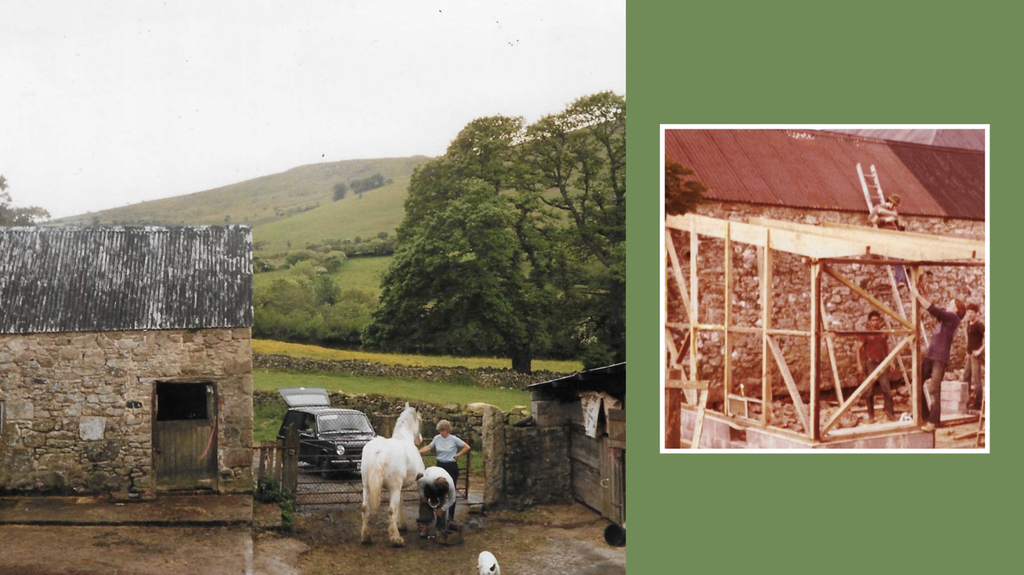
I went about three times with the youth group, and when the idea emerged to build a stable for the horses, I was recruited into Malcolm’s team of young workers. The next project was the erection of the assault course by the river, which for years was a source of joy for so many young people. By this time I was hooked by Shallowford. I had a long conversation with Miss Braund about staying on, and it was arranged that I would do a Youth Training Scheme at the farm, living in the farmhouse, getting involved with whatever was going on.
It was during that time that Elizabeth bought Bridie the shire horse. I was with her when the purchase was made along with the working equipment. We both undertook training with a horse expert called Charles Penny. A week’s course in Somerset, learning to drive heavy horses, and coming back to Shallowford to put it into action. Most of the time it was me working the horse off the long reins, with Bridie pulling the chain harrows. There was hay turning and cart work also. In the end Bridie proved too nervous a horse to work with, and we stopped working her; but she went on to breed several foals.
One thing Shallowford gave me was independence. It was an amazing opportunity for a lad from Scholey House, Battersea. It was brilliant. What an opportunity!
Miss Braund gave you the chance to succeed with something. If you did things wrong, she would tell you, but she gave you the second chance, and the third chance. It was about being steered in the right direction. I needed that because in Battersea I wasn’t far from going in wrong ways and flirting with criminal behaviour. Shallowford gave me responsibility and opportunity.
In my time at Shallowford I had lots of contact with local farmers, which made the experience all the richer. There was Peter Dracup at Broadaford, and Richard Norrish from Foxworthy, always being called in to help with some problem. Numerous times I was sent to the Zabs, when they needed an extra hand, and even to drive tractors. Alec Turner at Corndon was a character, naming his chickens after tennis players, and then training his sheep dog to go and fetch ‘McEnroe’ for example.
I had gone back to London for the weekend, when the great fire in the barn took place. Possible suspicion fell on a couple of boys, who had been placed there via social services; but it took a long time before Miss Braund was able to get it rebuilt and re-roofed, and by that time I had moved on from Shallowford. It wasn’t until Elizabeth’s 90th birthday celebration in 2011 that I returned again with some friends, and saw how the barn had been restored, and of course the farmhouse. I must now visit to see all the new refurbishments which I have only glimpsed on Facebook.
Shallowford showed me there was more. There was more out there, that was bigger than the confines of south London. I wanted to be part of that something bigger. After leaving Shallowford, interestingly through people I had met at Dunstone Methodist Church, I took a job on a dairy farm in the Tamar Valley. The work was good, but without a car, it was lonely, so I returned to London after a while. I had a series of unskilled jobs, but then, partly from Malcolm’s inspiration, became apprenticed to a carpenter, which set me up for several years.
My working life has taken me across Europe and into Australia, with jobs as varied as zookeeper, grounds maintenance and event management. Now I have re-connected with Shallowford, and I will make a point of returning.
There is no doubt that I went to Shallowford as one person, and came back completely different. Clearly it showed a city boy another side of life. I think it had a bigger effect than I first realised, like it planted something to grow.
What I would say about Elizabeth is that she had a good heart. Yes, she bellowed from the doorway of the kitchen. Yes, we got told off; but yes, she had just had such a good heart. She really did.
Rosemary was a fountain of knowledge. I was staggered about all her farming and nature information she had to share. She was such a huge part of that farm. She had some great one-liners. Here’s my favourite: It’s nice to be important. It’s more important to be nice.’


